
Sun, 29 Nov 2026
post
Tech Mentor

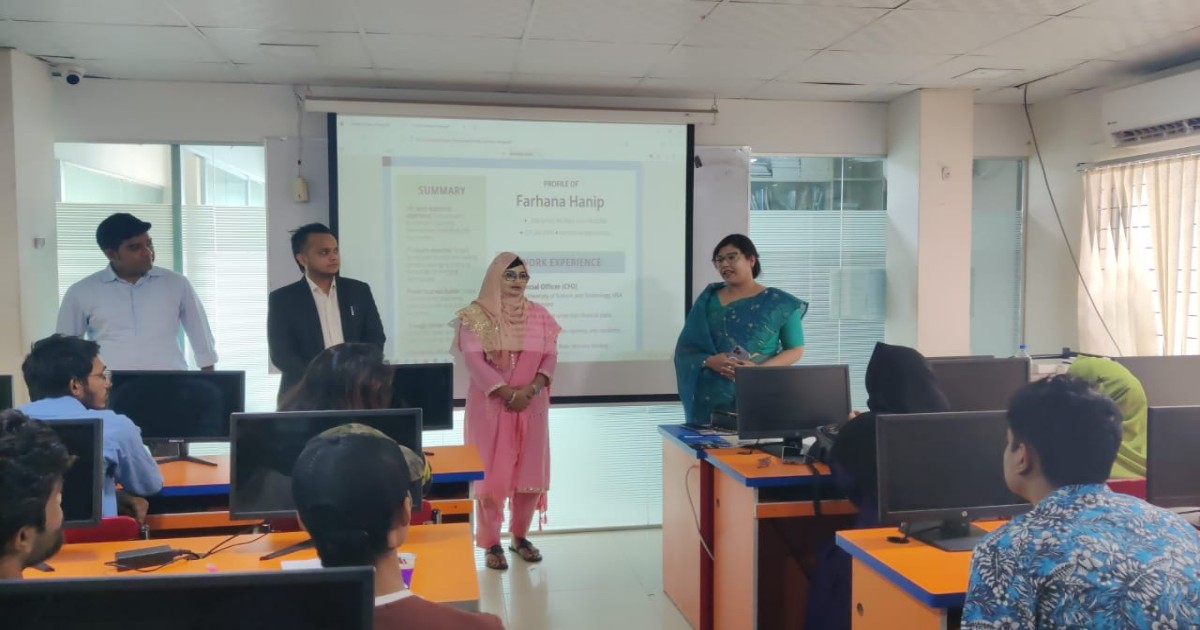
WUST CFO Holds Informative Session with Aspiring Students in Bangladesh

In a bid to foster educational opportunities for aspiring Bangladeshi students, the Chief Financial Officer of Washington University of Science and Technology and the President of PeopleNtech, Farhana Hanip, conducted a crucial meeting with prospective students interested in pursuing higher education in the United States. This significant event took place at PeopleNtech's Bangladesh campus on August 19th, commencing at 11 AM.The meeting served as an informative platform for attendees, where a wide array of topics related to higher education in the United States were deliberated upon. The agenda encompassed essential aspects such as eligibility criteria for admissions, scholarship opportunities, tuition fees, and the cost of living in the United States, among other pertinent subjects. Farhana Hanip underscored the invaluable opportunities they have meticulously curated for Bangladeshi students, particularly in their pursuit of higher education in the United States.In response to the pivotal question of why students should consider Washington University of Science and Technology for their higher education journey, Farhana Hanip provided insightful perspective. She expounded on the relentless dedication of PeopleNtech and Washington University of Science and Technology towards enhancing the American education system. Hanip revealed that the seeds they planted years ago, starting from the depths of the IT sector's basement, have now flourished and extended their reach to various Bangladeshi expatriate communities across the United States.Farhana Hanip proudly highlighted PeopleNtech's remarkable achievement of transforming over eight thousand students into adept IT professionals, with a significant number receiving their training at PeopleNtech, now recognized as one of the premier IT training centers in the United States.Moreover, in tune with the evolving educational landscape, Farhana Hanip disclosed that PeopleNtech and Washington University of Science and Technology are collaborating vigorously to offer students the opportunity to gain practical work experience while pursuing their four-year degrees. She also revealed that PeopleNtech Institute of Information Technology extends special discounts to students enrolling in various courses at Washington University of Science and Technology, making quality education even more accessible.The event witnessed the presence of notable dignitaries, including Mashrul Hussain Khan Leon, Vice President of PeopleNtech Institute of IT, Abdul Hamid, Chief Operating Officer of PeopleNtech, and Mashuma Bhuyan Farha, the university's esteemed representative in Bangladesh.The meeting not only showcased the dedication of Washington University of Science and Technology and PeopleNtech in shaping the future of Bangladeshi students but also underscored their commitment to fostering educational excellence on a global scale.

post
NRB Success

PeopleNTech Elevates Bangladesh's Digital Landscape

The foundation of a "Smart Bangladesh" is firmly rooted in digital connectivity, aligning with Prime Minister Sheikh Hasina's visionary pursuit of creating both a "Smart Bangladesh" and a "Smart Nation." This transformative journey towards a smarter nation is the next significant milestone on Bangladesh's horizon.To realize the goal of building a Smart Bangladesh, PeopleNtech Bangladesh is strategically focusing its efforts on cybersecurity and artificial intelligence. The institution has already embarked on programs dedicated to these cutting-edge fields. It is worth noting that the primary hub for cybersecurity and artificial intelligence will find its home in Keraniganj, Dhaka. This significant development was officially announced by Farhana Hanip, the President of PeopleNtech Bangladesh, who concurrently holds the position of Chief Financial Officer at the Washington University of Science and Technology.PeopleNtech Institute of IT is actively engaged in Bangladesh and two other countries, harnessing the potential of digital technologies such as cybersecurity, artificial intelligence, virtual reality, augmented reality, robotics, and big data to usher in economic prosperity.Founded in 2005, PeopleNtech Institute of IT has already solidified its position as a successful model in the realms of education and job placement. It serves as a testament to the institution's commitment to fostering excellence.Farhana Hanip, currently residing in Virginia, United States, boasts a robust background in Information Technology and Cybersecurity Engineering. Her impressive credentials include advanced degrees from Stayer University in the United States, with her pursuit of an MBA in Leadership Management underway at George Washington University. With over two decades of professional experience spanning some of the finest IT companies in the United States, India, and Bangladesh, Farhana Hanip shoulders the responsibility of leadership and ownership at PeopleNtech across these three nations.In addition to her distinguished role in the private sector, Farhana Hanip actively contributes to the public and government sectors in the United States. She collaborates closely with the Women Impacting Public Policy (WIPP) organization in Washington, D.C.Notably, Farhana Hanip recently visited Bangladesh in her capacity as President of PeopleNtech. During her visit, she graced the RTV reality show 'Youngstar' on August 16th and extended a courteous visit to the American Embassy's spokesperson, Bryan Schiller, accompanied by his wife Marcia Schiller. This auspicious occasion witnessed the presence of Bangladesh's Foreign Minister, Dr. A. K. Abdul Momen, and RTV Chairman Alhajj Morshed Alam.Farhana Hanip took the opportunity to share some remarkable achievements: "Nearly eight thousand students, predominantly women, are currently gainfully employed in the IT sector, thanks to training from PeopleNtech.Beyond various projects in Bangladesh, productive dialogues have transpired with the University Grants Commission and the Hi-Tech Park in Bangladesh. Presently, PeopleNtech has emerged as a preeminent IT training center, standing tall in the United States, Bangladesh, and India."The collaborative efforts of PeopleNtech and the Washington University of Science and Technology are being celebrated and appreciated in Bangladesh, much to the delight of the American Ambassador, Bryan Schiller. He assured continued cooperation with both institutions to bolster their partnership.Farhana Hanip's current aspiration is to empower unemployed youths in Dhaka-1 and Dhaka-2 constituencies through IT education, equipping them to become self-reliant. She stated, "I aspire to provide the youth of my cherished districts, 1 and 2, with opportunities to work internationally without leaving their homeland.PeopleNtech stands unwaveringly by their side, facilitating skill development and imparting IT education to pave the way for abundant job opportunities."Her commitment extends to providing comprehensive support for the education and IT training of the youth in the Jinjira area of Dhaka district.In addition to its remarkable initiatives, Abubokor Hanip, the founder and CEO of PeopleNtech, has established the Washington University of Science and Technology as the first Bangladeshi-owned university in the United States.Farhana Hanip emphasized their ongoing dedication: "As time unfolds, we will persistently strive to ensure that the youth of Bangladesh, especially those in Dhaka-1 and Dhaka-2 constituencies, receive IT education and training to enable them to achieve global excellence while staying within their homeland." She also assured full cooperation with the Washington University of Science and Technology, including special discounts for admission to various courses at the university.Recently, Poniruzzaman Tarun, the President of the Dhaka District Unit Awami League, visited the PeopleNtech Institute of IT and was highly impressed by its programs. Additionally, Sakur Hossain Sakku, the Organizing Secretary of the Dhaka District Unit Awami League and the Chairman of the Jhinjira Union Parishad, expressed admiration upon witnessing the impactful activities of PeopleNtech and the Washington University of Science and Technology.During the visit, Sakku proposed the organization of seminars focused on skill development and higher education in the United States for the students, further highlighting the commitment to empowering the youth of Bangladesh.By Abu Jakir

post
News

It’s the summer of changed climate. Get used to it

Here’s a hot take on the summer of 2023: The climate you grew up in is gone, replaced by something new and changing, but also inalterably different – where the Atlantic Ocean can reach hot-tub temperature, heat is a recurring public health concern and people will have to adapt their way of living. In this year of epic heat, it’s time to start thinking about how the climate changed rather than the fact of its changing. From a historical standpoint, we are in uncharted territory. This is not just the hottest month in human history. It may be the hottest month in 120,000 years, according to scientists in Europe. From a daily life standpoint, things are different Nearly half the US is under a heat advisory this week, and the country’s largest power grid was on alert. The warnings that more fires, floods and storms would occur as the atmosphere heated up are here. A large portion of the country has seen smoke come and go from those Canadian wildfires. Tourists in Greece were forced to flee in the country’s largest-ever evacuation. Towns unused to flooding were under water this year in Vermont. Torrential rain flooded Boston’s Fenway park. The same weather won’t occur every year The West Coast of the US, for instance, has gotten a respite so far from wildfires thanks to epic rainfall earlier in the year. But we can expect more heat more often. Asked by CNN’s Zain Asher about a heat index in Iran that approached 150 degrees Fahrenheit, Marina Romanello, executive director of the Lancet Countdown on Health and Climate Change, said to prepare for more. “What we know is the heat will become much more intense, much more frequent, and that if we don’t act urgently to reduce greenhouse gas emissions, then the outlook will be very serious with, as you said, temperatures that are beyond the limits of physiological survival.” Are we acting urgently? Asher pointed out California is phasing out gas-powered car sales. Romanello said the basic move would be to commit to phase out fossil fuels. But countries are not yet on that path or anywhere close to it. When the new extremes come, they feel remarkable Take a look at Arizona, where Phoenix has endured nearly a full straight month of 110-plus-degree days. Cacti can’t stand the heat and are dying. Hospitals have been taxed. Doctors are treating people burned just by falling on the ground, according to one CNN report. The Phoenix area medical examiner has brought in extra refrigerated containers for bodies, like it did during spikes of Covid-19, to deal with potential overflow. Maricopa County has 25 heat-related deaths so far, but another 249 are under investigation. Cities like Phoenix are urban hot boxes The urban density that creates economic opportunity also makes cities hotter than their surrounding areas. There can be variation up to 8 degrees between portions of a city with trees and green space and those that are mostly pavement. “These giant swings in temperature over short distances in cities, known as the urban heat island effect, make heat waves even worse,” writes CNN’s Rachel Ramirez of a new report by the nonprofit research group Climate Central. “Areas blanketed with asphalt, buildings, industry and freeways tend to absorb the sun’s energy then radiate more heat, while areas with abundant green space – parks, rivers, and tree-lined streets – radiate less heat and provide shade.” Ramirez notes that cities are looking for new ways to adapt, like painting roads white in Los Angeles, painting roofs in New York and more. In hot water Coral reefs off the Florida Keys, unable to stand the 100-plus-degree temperatures charted in some areas, are suffering a mass bleaching event, according to CNN’s Eric Zerkel, who writes experts were stunned at the two-week escalation that could kill some reefs off. That’s a very real and grim consequence. More theoretical is the possibility that the series of currents that circulates water around the oceans simply collapses. A study published in the journal Nature this week suggested the Atlantic Meridional Overturning Current, which includes the Gulf Stream, could collapse as early as 2025. Melting ice could dilute ocean water and alter the currents, which would affect everyone on the planet. There’s a climate change angle for everywhere and everything The reason gas prices have spiked in recent days? On top of OPEC holding back supply, excessive heat is affecting productivity at oil refineries. In the US, while President Joe Biden has made pledges to make the US carbon neutral in the coming decades, he is not completely opposed to new oil projects. It was seen as a political win for him and West Virginia Sen. Joe Manchin, a Democrat, that the Supreme Court cleared the way Thursday for a new pipeline running through West Virginia. That news came the same day the White House announced new relief measures for people suffering from the record heat, including the creation of a new “heat hazard alert” system to clarify precautions for workers. “I don’t think anybody can deny the impact of climate change anymore,” Biden said, announcing the measures. What’s the priority here? A majority of Americans – 52% – said in Gallup survey in March, before this heat wave, that protecting the environment should be prioritized even if it hurts the economy. That’s compared with 43% who said the government should prioritize economic growth even if it hurts the environment. However. The numbers may fluctuate depending on how people feel about the health of the economy. But the share who prioritize economic growth over the environment has on the whole risen in Gallup’s polling over the long term. Between 1985 and 2002, that number never topped 40%. The partisan divide over climate change is also the largest it has ever been. Enjoy your vacation The geophysicist Bill McGuire, a professor at University College London and author of “Hothouse Earth: An Inhabitant’s Guide,” writes for CNN Opinion this week that people’s vacations as we know them are over. He points to tourists who had to flee the island of Rhodes in Greece to get away from wildfires. “It would be a big mistake to regard these as freak events and to continue holidaying as usual in the years ahead,” McGuire writes. “On the contrary, the extreme weather conditions across southern Europe this summer are a wake-up call – a reminder that not even our vacations are insulated from the growing consequences of global heating.” Credit: CNN

post
News

Earth Will Continue to Warm and the Effects Will Be Profound

Global climate change is not a future problem. Changes to Earth’s climate driven by increased human emissions of heat-trapping greenhouse gases are already having widespread effects on the environment: glaciers and ice sheets are shrinking, river and lake ice is breaking up earlier, plant and animal geographic ranges are shifting, and plants and trees are blooming sooner. Effects that scientists had long predicted would result from global climate change are now occurring, such as sea ice loss, accelerated sea level rise, and longer, more intense heat waves. Some changes (such as droughts, wildfires, and extreme rainfall) are happening faster than scientists previously assessed. In fact, according to the Intergovernmental Panel on Climate Change (IPCC) — the United Nations body established to assess the science related to climate change — modern humans have never before seen the observed changes in our global climate, and some of these changes are irreversible over the next hundreds to thousands of years. Scientists have high confidence that global temperatures will continue to rise for many decades, mainly due to greenhouse gases produced by human activities. The IPCC’s Sixth Assessment report, published in 2021, found that human emissions of heat-trapping gases have already warmed the climate by nearly 2 degrees Fahrenheit (1.1 degrees Celsius) since pre-Industrial times (starting in 1750).1 The global average temperature is expected to reach or exceed 1.5 degrees C (about 3 degrees F) within the next few decades. These changes will affect all regions of Earth. What’s the difference between climate change and global warming? The severity of effects caused by climate change will depend on the path of future human activities. More greenhouse gas emissions will lead to more climate extremes and widespread damaging effects across our planet. However, those future effects depend on the total amount of carbon dioxide we emit. So, if we can reduce emissions, we may avoid some of the worst effects.

About Us

NRBC is an open news and tele video entertainment platform for non-residential Bengali network across the globe with no-business vision just to deliver news to the Bengali community.