
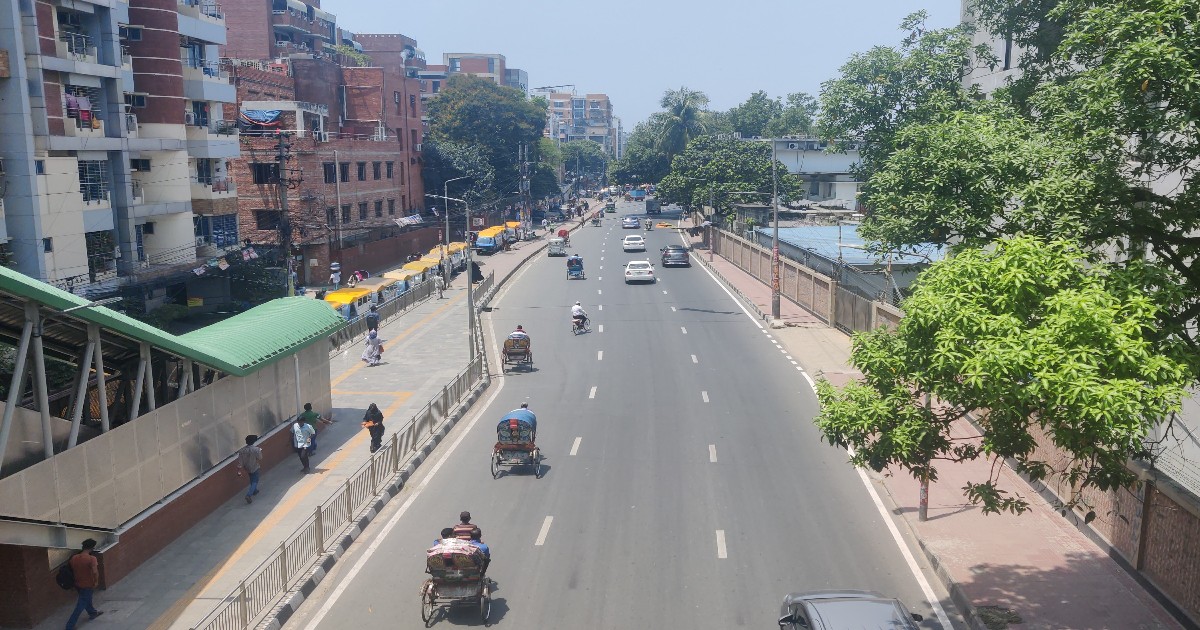
By Abu Jakir
As soon as one steps out of the house, it feels like a scorching desert wind is blowing. The intense heat is accompanied by humidity, causing the body to feel sticky. Sweat is dripping down constantly. During this time, occasional pre-monsoon showers and the coolness of Baisakh are sometimes a relief; however, even that is absent this time. April, like the past two years, seems to have turned terribly harsh.
In some parts of the Rajshahi and Khulna divisions, the summer heat is severe. Due to the rising temperatures, the discomfort of the heat was quite intense. In the last ten years, from March to July, the heatwave has been increasing intermittently throughout 80% of the country. The most excruciating suffering during this month is caused by the combination of extreme heat and humidity, known as the "wet bulb globe temperature" (WBGT). This kind of extreme heat is beginning to take the form of fatal calamities such as heatstroke and cyclones.
In April, the average temperature in Bangladesh is 33 degrees Celsius. However, for the past week, it has remained between 35 to 37 degrees Celsius. Yesterday, Saturday, the highest temperature in the country was 42.6 degrees Celsius in Jessore. The temperature in Dhaka exceeded 40 degrees Celsius. The average temperature throughout the country was more than 36 degrees Celsius.
To mitigate the suffering of the students due to the intense heat, educational institutions have been closed for a week.
According to the Meteorological Department, for the rest of the current month, the heatwave is expected to continue. The heatwave will be at its peak during the first week of May throughout the country. The danger of extreme heat and humidity may persist until July-August. Therefore, experts have advised making plans and taking initiatives on how to cope with this type of weather, and how to stay healthy during this heat.
Professor Shamsuddin Shahid, a researcher on temperature issues and a professor at the University of Technology in Malaysia, said that in Bangladesh, merely the intensity of the temperature will not make people understand the suffering and danger. Even if the temperature does not exceed 36 degrees Celsius, a dangerous situation may arise. If the temperature remains between 30 to 35 degrees Celsius and humidity exceeds 40%, and there is a low airflow, there may be a risk of extreme heat. In April, this extreme heat is occurring in Bangladesh.
Professor Shamsuddin Shahid further stated that this disaster should be taken as seriously as about eight to ten other disasters. To cope with this type of weather, it is necessary to provide shade through public initiatives like drinking water, trees, and other infrastructures.
According to the Meteorological Department, in February of the current year, a research report titled "Impact of Climate Change in Bangladesh" was published. It shows that in the last 60 years, the temperature in April has risen rapidly to a dangerous level. In most parts of the country during this month, more than half the time, the heatwave is prevalent. In other years, during this time, there were several consecutive days of frequent nor'westers, storms, and rain. This led to a slight decrease in the temperature. This time there is neither rain nor wind. For four consecutive days, the maximum temperature in 70% of the country exceeded 35 degrees Celsius. And yesterday, the maximum temperature in at least 12 districts of the country was more than 40 degrees Celsius.
According to the Meteorological Department, in April, the humidity or moisture in the air is usually 75%; however, for most of the time this month, it was between 85% to 90%. Yesterday, the humidity in Dhaka was 89%.
If the temperature rises above 40 degrees Celsius in most parts of East Asia, including Bangladesh, a dangerous weather condition is declared. And when the temperature exceeds 32 degrees Celsius and humidity exceeds 30%, it is announced as hazardous weather.
A study conducted by the Bangladesh Meteorological Department in 2022 titled "Analysis of the Summer Temperature Flow in Bangladesh" shows that the temperature flow is highest in April. According to the scientists who conducted the research together with the former meteorologist at the Meteorological Department Abdul Mannan, the hottest temperatures are in the divisions of Rajshahi, Khulna, Dhaka, and Barisal.
The research reveals that people are suffering due to the extreme heat. This extreme temperature has led to various types of diseases and an increase in mortality. The high temperature in the city is creating a water and electricity crisis. In addition, it is reducing crop production and creating adverse conditions. The extreme heat is also affecting people's mood and creating social unrest.
Meteorologist Bajlur Rashid of the Meteorological Department stated that due to the excess temperature and other factors in April, it is becoming increasingly fatal. Therefore, related organizations need to make immediate plans for public health, agriculture, and livestock safety.